
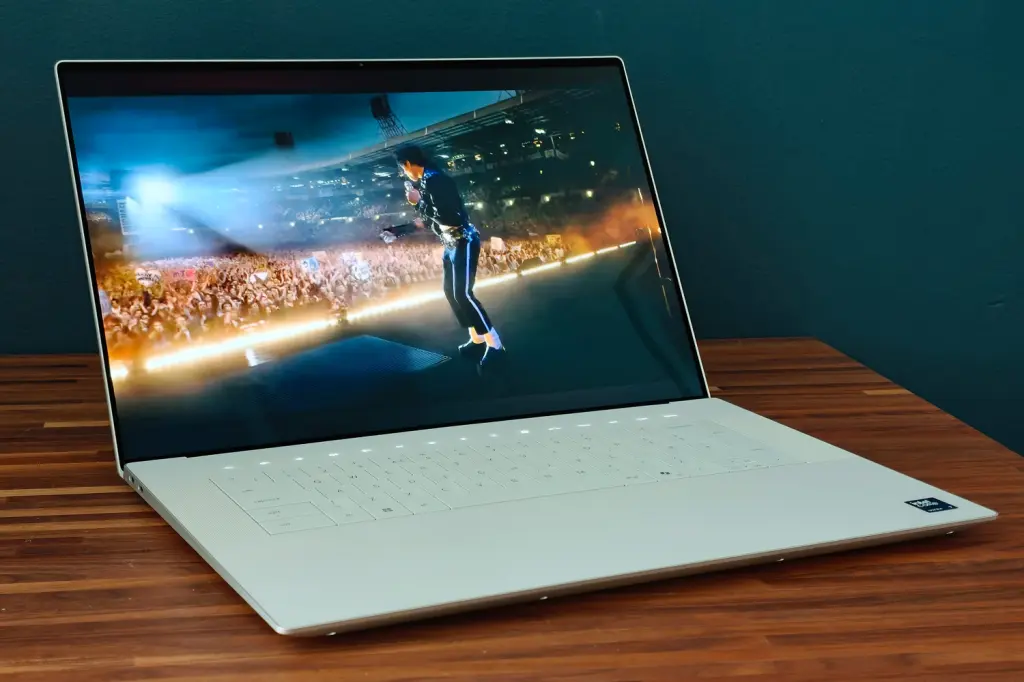
We haven’t even had a full year to process the disappearance of Dell’s iconic XPS branding, and I’m honestly still not over it. But the industry moves on. Engadget has already taken a look at the Dell 14 Premium — formerly the XPS 14 — and I’ve now spent time with the larger Dell 16 Premium. My takeaway? It’s just as striking as the last XPS 16, but Dell really needs to reconsider its ultra-modern design philosophy.
With its stripped-back aesthetic (no visible trackpad in sight), smooth metal chassis, and ultra-clean lines, the Dell 16 Premium looks like a piece of industrial art. It feels like something dreamed up for a ’90s sci-fi film, back when laptops were still bulky gray slabs. Unfortunately, those looks come with trade-offs — both in cost (starting at $2,000) and everyday usability.
Dell 16 Premium
Dell’s 16 Premium is undeniably gorgeous, but the usability flaws that plagued the XPS lineup are still here.
Pros
- Elegant minimalist design
- Strong performance
- Comfortable keyboard
Cons
- Invisible trackpad hurts usability
- Capacitive function row vanishes in bright light
- Port selection is too limited
- Underwhelming battery life
If you’ve read my reviews of the XPS 16 and XPS 13 Plus — Dell’s first laptops to adopt this design language — you might think I’m repeating myself. But more than three years after I first criticized Dell for prioritizing aesthetics over practicality, it’s worth saying again: the company doesn’t seem to have learned much. Yes, performance has improved thanks to Intel’s Core Ultra processors and NVIDIA’s RTX 50-series GPUs, but that alone doesn’t fix the fundamentals.
I still struggle with the 16 Premium’s borderless trackpad, since it’s difficult to tell where the click zones begin and end. I still dislike the capacitive function row — it practically disappears in bright sunlight, and it’s nearly impossible to build muscle memory for tasks like adjusting brightness or volume. And I genuinely don’t understand how Dell can justify offering only USB-C ports and a microSD slot on a laptop aimed at professionals. Even Apple eventually admitted defeat and brought back more ports, as have PC makers like ASUS and Acer. Somehow, Dell seems to have missed that lesson.
The Dell 16 Premium from the rear doesn’t inspire much more confidence, either.
What’s most disappointing is the impact of the 4K OLED display on battery life. During a simple video rundown, the 16 Premium lasted just six hours and five minutes. By comparison, the previous XPS 16 managed eight and a half hours in the more demanding PCMark 10 battery test. (That benchmark wouldn’t run properly on my 16 Premium review unit for reasons unknown.) You’d expect a larger laptop to compensate with a bigger battery, but that doesn’t seem to be the case here.
At least performance has taken a step forward. My review unit was equipped with Intel’s Core Ultra 7 255H processor and a low-power version of NVIDIA’s RTX 5070 GPU. It scored roughly 10 percent higher than last year’s XPS 16 in PCMark 10, and it showed noticeable gains in Geekbench AI thanks to Intel’s improved NPU. I was even able to run Cyberpunk 2077 at 4K and 84 fps with DLSS 4 frame generation enabled. Oddly, though, ray tracing caused the system to grind to a near halt. Even at 1080p with low ray tracing settings, performance hovered around 60 fps.
This isn’t a gaming laptop, so comparisons to something like the Razer Blade 16 aren’t entirely fair. Still, it’s strange to see one of NVIDIA’s newest GPUs struggle so much with ray tracing. As expected, fan noise ramps up significantly under load, though thermals remain reasonable — the CPU and GPU stabilized at 68°C and 70°C, respectively.
The longer I stared at the Dell 16 Premium’s beautiful exterior, the more I wished it offered more substance. It needs additional ports — HDMI and a full-sized SD card reader, at the very least. It needs physical function keys that remain visible in bright environments and stay fixed in place. And honestly, Dell should abandon the invisible trackpad altogether. It’s a flashy gimmick that makes left- and right-clicks harder to distinguish, despite the generous surface area.
Given its premium status, I also expected better speakers. They’re decent by Windows laptop standards, but they fall far short of what Apple delivers with the 16-inch MacBook Pro. Music lacks depth and dynamic range, whereas Apple’s speakers regularly surprise me with their richness and presence. During late-night writing sessions, I’m far more inclined to play music directly through the MacBook Pro than rely on the Dell 16 Premium, which usually sends me reaching for external speakers.
To end on a less critical note: I genuinely enjoy looking at the Dell 16 Premium. I appreciate how the keyboard and oversized keycaps sit flush with the lower deck, and the 16-inch OLED panel can look stunningly vibrant at the right moments. I just want Dell’s designers to strike a better balance between style and usability the next time they tackle a premium 16-inch laptop.