
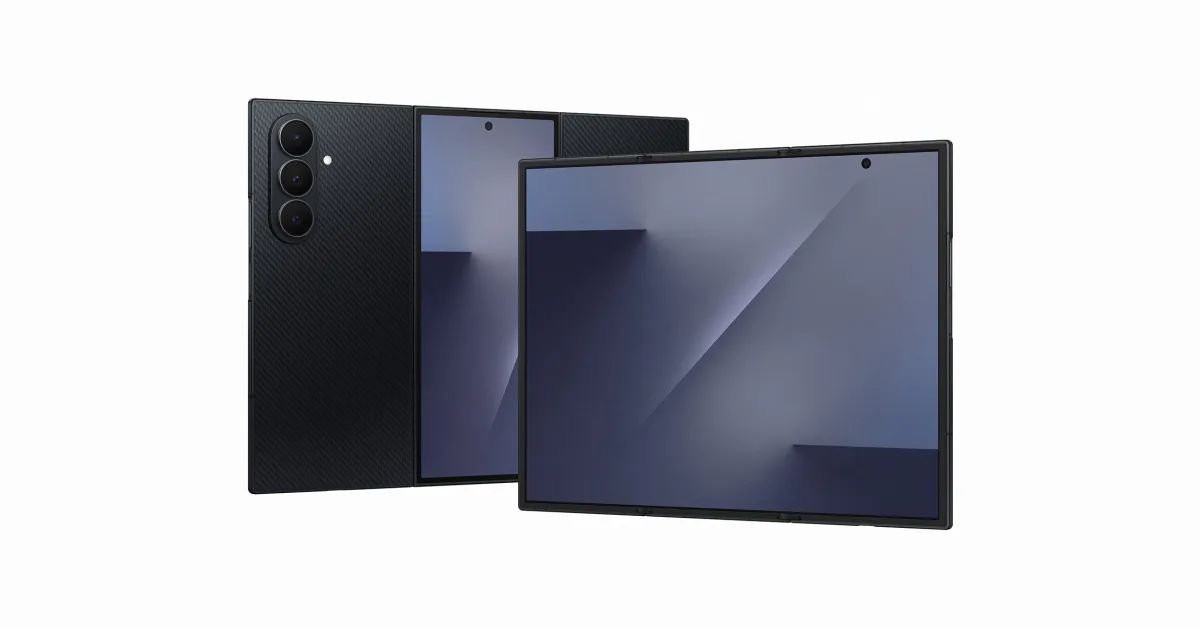
Samsung escalated competition in the foldable smartphone space on Tuesday by unveiling the Galaxy Z TriFold.
The three-panel handset unfolds into a 10-inch QXGA+ display (2160 × 1584) featuring up to 1,600 nits of peak brightness and a 120Hz refresh rate.
Its two outer panels fold inward to shield the primary screen, and an automatic warning system alerts users if the device is folded improperly.
The phone can run three portrait-format apps at once — one per panel — or stretch a single app across all three displays. It also supports use with an external monitor.
When folded, the device measures 12.9 mm thick; when fully opened, it tapers to just 3.9 mm at its thinnest point. For context, the iPhone 17 Pro is 8.75 mm thick, while Apple’s slimmest phone, the iPhone Air, measures 5.64 mm.
Available only in black, the phone will ship with 16GB of RAM and either 512GB or 1TB of storage, with no option for MicroSD expansion.
Powering the device is a customized Snapdragon 8 Elite Mobile processor paired with a 5,600 mAh three-cell battery, with one battery cell housed in each display section.
On the back, the camera setup includes a 12MP ultra-wide lens, a 200MP main camera, and a 10MP telephoto lens offering 3x optical and 30x digital zoom.
There are also two 10MP front-facing cameras — one embedded in the cover display and another on the main screen.
Samsung describes the TriFold as its most advanced foldable yet, combining a redesigned dual-hinge mechanism with a reinforced display and more durable exterior materials, including a titanium hinge enclosure and an Advanced Armor Aluminum frame. The device will launch in South Korea on Dec. 12 before expanding to other markets, including the U.S., with a reported price of $2,440.
A Stronger Replacement Device
According to Kristen Hanich, director of research at Parks Associates in Dallas, a tri-fold smartphone offers a superior two-in-one experience compared to bi-fold designs.
“The form factor makes it easier to use as a phone while still delivering a much larger tablet-style display when unfolded,” she told TechNewsWorld. “It works better as both a phone replacement and a tablet replacement.”
Mark N. Vena, president and principal analyst at SmartTech Research in Las Vegas, added that a tri-fold essentially allows users to carry a 10-inch tablet in a device that still fits in a pocket.
“It provides power users with more space for multitasking, content creation, and productivity than even current book-style foldables,” he said. “It’s less about basic phone functions and more about replacing a secondary device.”
Tri-folds also offer advantages for the roughly 34 million Americans who wear reading glasses, noted Rob Enderle, president and principal analyst at the Enderle Group in Bend, Oregon. The expanded screen makes it easier to enlarge text while still displaying a substantial amount of content.
“It’s also better suited for video consumption, especially for frequent travelers,” he told TechNewsWorld. “And because tri-folds are still rare, they carry a certain status appeal.”
A Niche Audience
Tim Bajarin, president of Creative Strategies in San Jose, California, argued that there is currently little market demand for tri-fold smartphones.
“The Galaxy TriFold is really about showcasing Samsung’s design capability and innovation,” he told TechNewsWorld.
Tuong Huy Nguyen, a director analyst for emerging technologies at Gartner in Stamford, Connecticut, said the main obstacle for foldables isn’t engineering, but market adoption.
“The issue isn’t technical — it’s whether there’s compelling content, apps, and services that deliver enough value,” he explained. “Foldables lack an ecosystem that truly takes advantage of the form factor.”
He added that unless prices fall significantly or foldables offer clear utility that justifies their cost, they will remain a niche category.
Bajarin agreed that foldables are currently niche but suggested that the situation could change quickly. If Apple were to introduce a folding iPhone, consumer interest could surge dramatically.
“Apple won’t enter the category until the technology meets its standards,” he said. “But when it does, Apple’s marketing strength could significantly elevate interest in foldable phones.”
Apple’s Developer Advantage
Beyond marketing, Apple could also bring stronger developer support to foldables. Ross Rubin, principal analyst at Reticle Research in New York City, noted that developers have historically been more willing to optimize software for Apple hardware.
“We saw this with the iPad, where apps evolved far beyond their original iPhone versions, something Android tablets struggled to match,” he told TechNewsWorld.
Rubin also pointed out that Samsung’s timing is notable, as Google is exploring ways to merge Android with elements of Chrome OS — an effort that could improve support for larger screens.
“There’s a perception that Apple is behind in foldables because Samsung already offers book-style, flip-style, and tri-fold devices, while Apple sticks with traditional slabs,” Vena added. “But Apple typically waits until it can deliver durability, thinness, and app experiences that feel seamless.”
“The real question is whether consumers will still care about foldables when Apple eventually enters the space,” he continued. “Ironically, Samsung may want Apple to validate the category, since broader acceptance would benefit everyone.”
Tablet Disruptors
Vena maintained that tri-folds aren’t gimmicks but experiments in pushing the smartphone toward becoming a primary computing device. The real breakthrough, he said, will come when software and AI fully exploit the larger display for smarter multitasking.
Enderle echoed that sentiment, noting that after years of using foldables — including the Google Pixel Fold and the Microsoft Duo — he couldn’t return to a standard phone.
“Still,” he said, “a tri-fold may be a step too far for me, both in terms of price and because the flexible display is more exposed and mechanically vulnerable.”
Foldables aren’t for everyone, added Anshel Sag, a senior analyst at Moor Insights & Strategy in Austin, Texas.
“They’re an ultra-premium niche today, but over time they may cannibalize more of the tablet market,” he told TechNewsWorld. “I rarely use a tablet anymore, but a foldable has become essential to my daily routine.”
Hanich concluded that tri-fold devices represent an exciting evolution in mobile computing, functioning not just as smartphone and tablet replacements, but potentially even as laptop alternatives.