
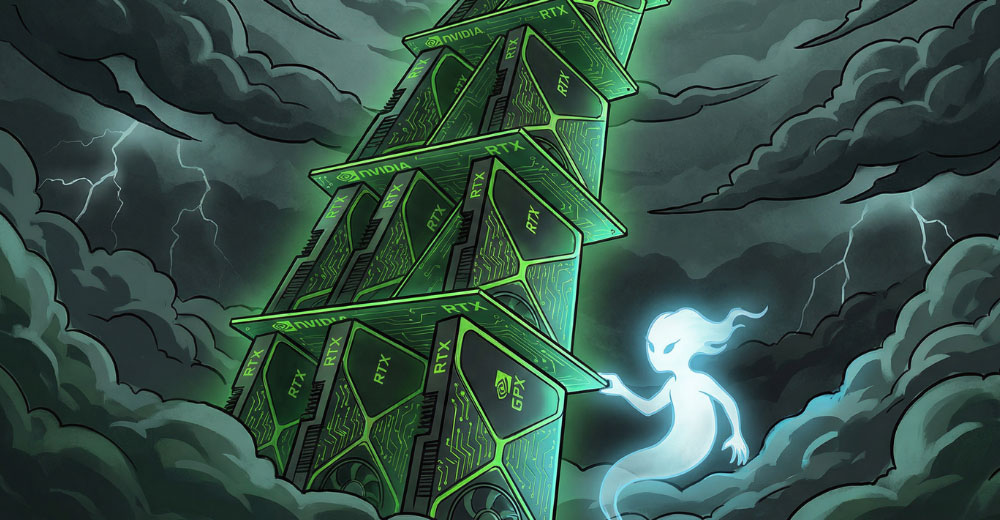
The atmosphere is thinning at these heights. Nvidia has just broken records, soaring to an astonishing $5 trillion market capitalization — a figure that seems to defy physics, common sense, and historical precedent.
Yet a closer look at what supports this enormous valuation reveals something unexpected. The structure isn’t upheld by unmatched silicon or some mystical AI breakthrough. Instead, it rests on a software-based lock-in called CUDA. And thanks to a little-known company named Spectral Compute, that support may soon crumble.
We are approaching a major reckoning in the AI sector — one that could drag Nvidia’s valuation back down to earth. The trigger won’t be a superior processor from AMD or Intel, but software that renders the hardware itself interchangeable.
Let’s examine how Spectral might dismantle Nvidia’s carefully built dominance. After that, I’ll wrap up with my Product of the Week: HP’s OmniBook 5 Laptop 16″ AI PC.
The CUDA Cage
How did Nvidia climb to a five-trillion-dollar valuation? It wasn’t simply by moving GPUs. If success were determined solely by hardware, AMD and Intel would have squeezed Nvidia’s margins long ago. Nvidia’s real achievement was building a fortress so formidable that developers felt trapped inside it. That fortress is CUDA — Compute Unified Device Architecture.
For more than ten years, Nvidia has relentlessly promoted CUDA as the only practical option for accelerated computing. It distributed CUDA freely to universities, captured researchers early, and ensured that the entire AI software ecosystem — from PyTorch to TensorFlow — performed best on Nvidia hardware. The strategy was textbook monopoly behavior: bind customers so tightly that leaving costs more than enduring ever-higher prices.
Investors saw this protective moat and imagined limitless upside. Nvidia was no longer priced as a chipmaker, but as the gatekeeper of the AI standard. Yet monopolies sustained by force rather than genuine choice tend to be inherently unstable.
Blackwell Red Flags
Signs of weakness are already emerging, and they’re coming from the very top. Microsoft — arguably Nvidia’s most critical client — has effectively raised a red flag.
Microsoft CEO Satya Nadella has grown increasingly outspoken about the operational headaches tied to Nvidia’s newest hardware. Though carefully worded, his remarks about having “chips sitting in inventory that I can’t plug in” point to a serious breakdown in Nvidia’s execution. The Blackwell architecture, marketed as the next big leap, has struggled with overheating and extreme power demands that existing data centers simply can’t handle.
When your largest customer says your product can’t be deployed in today’s environment, a responsive company adapts. But a company intoxicated by its lock-in advantage often pushes harder instead. Reports suggest Microsoft has reduced its Blackwell rack orders, a clear sign that the burden of sticking with Nvidia is beginning to outweigh the risk of moving on.
Enter Spectral: The Lock Pick
As industry titans wrestle with power constraints and thermal limits, a small UK-based startup — Spectral Compute — has quietly created what could be the master key to Nvidia’s CUDA lockup.

Almost nobody knows Spectral. It doesn’t stage flashy launches or feature a leather-jacketed figurehead. What it does have is a technology called Scale — a “C-to-silicon” compiler that enables CUDA applications to run natively on AMD hardware, and eventually on other platforms as well, without porting, without performance degradation, and without the persistent problems that doomed earlier translation efforts.
This isn’t a theoretical promise. Spectral’s solution works right now. For the first time, organizations can take vast amounts of existing CUDA code and run it on AMD’s MI300 — and future MI400 — processors simply by recompiling.
That reality completely changes the equation. Once CUDA workloads can operate on any silicon, Nvidia’s defensive moat disappears. Hardware reverts to being a commodity, and commodities do not justify valuations of 40 times revenue.
The Shift Is Underway
Spectral may be the most precise tool attacking the wall, but it isn’t alone. A growing, largely quiet coalition of companies is working to loosen CUDA’s hold on the industry.
Microsoft has been building its own toolchains to translate CUDA into ROCm, hoping to capitalize on its substantial investment in AMD hardware. AMD itself offers HIP and HIPIFY as portability solutions. Open-source initiatives, such as the recently revived Zluda project, are pursuing similar goals.
What sets Spectral apart is how seamless the process appears to be. If the transition truly becomes invisible, adoption will accelerate rapidly. CIOs, already strained by Nvidia’s extreme pricing and ongoing supply issues, will look at AMD’s comparable performance at a fraction of the cost and recognize that they finally have real leverage.
Lock-In Arrogance: A Lesson From IBM
I’ve witnessed this pattern before — firsthand.
During my time at IBM in the 1980s, I saw the same overconfidence that now surrounds Nvidia. IBM’s leadership genuinely believed customer sentiment was irrelevant. We weren’t merely selling mainframes; as one executive famously said, we were “selling air.” The message was clear: customers needed us to survive. They were bound to our hardware, our software, and our service agreements. We assumed escape wasn’t an option.
That mindset breeds institutional deafness. When you see customers as captives, you stop hearing their frustrations about cost, complexity, and energy consumption. Partnership gives way to extraction.
At IBM, this approach paved the way for the company’s near-collapse in the early 1990s. Once a credible alternative emerged — client-server computing — customers didn’t slowly migrate. They fled, fueled by years of resentment at being taken for granted. Nvidia is now cultivating that same bitterness among the hyperscalers and enterprises that sustain its dominance.
The Aftermath: When $5 Trillion Disappears
So what happens when the reckoning arrives?
If Spectral’s technology gains momentum — and I believe it’s a question of when, not if — Nvidia’s share price won’t merely decline; it will collapse. A $5 trillion valuation assumes unchallenged supremacy for decades. Discovering that Nvidia is simply another hardware supplier in a competitive landscape could erase 50% to 70% of its market value in short order.
The shockwaves would ripple across the entire technology sector. The AI bubble, inflated largely by Nvidia’s valuation multiple, would deflate abruptly. Companies that loaded up on debt to acquire H100s and Blackwell systems would watch those assets rapidly lose value.