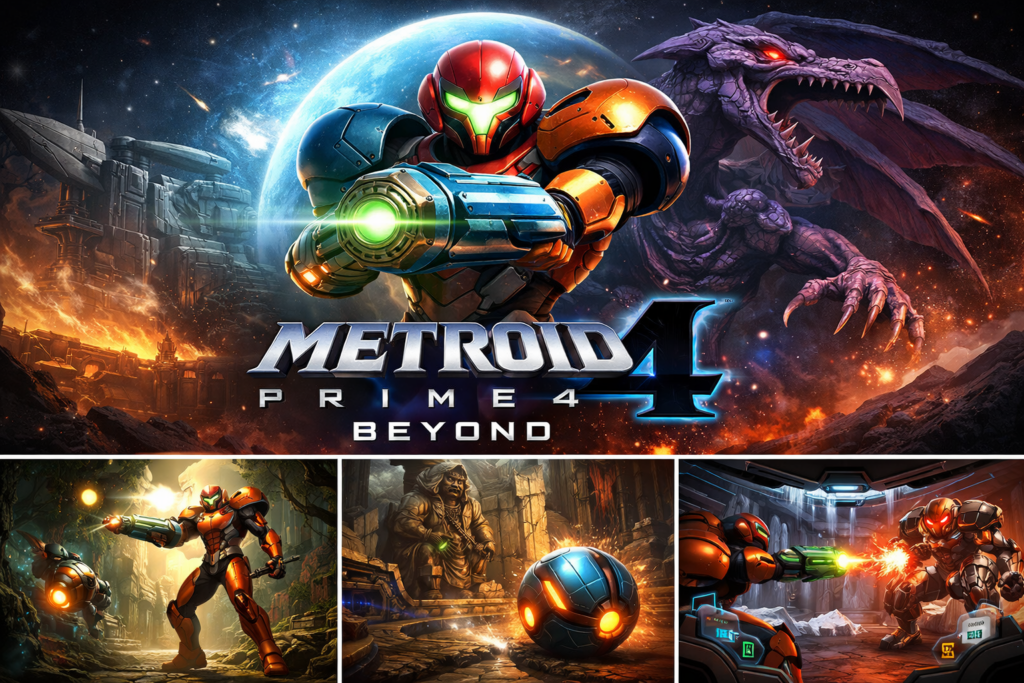
It’s been 18 years since the previous Metroid Prime entry, yet stepping into Metroid Prime 4: Beyond felt immediately familiar — perhaps too familiar. Whether I was battling enemies inside a volcano, roaming a frozen research facility or wandering through an expansive desert, I constantly had the sense that I’d done all of this before. For a fourth installment in a long-running series, that’s not entirely unexpected, but it was my biggest letdown with Beyond. Compare that to the transformation Nintendo achieved between 2011’s The Legend of Zelda: Skyward Sword and 2017’s Breath of the Wild. Both were unmistakably Zelda games, yet Nintendo fundamentally reimagined what the series could be.
That kind of reinvention doesn’t happen in Metroid Prime 4: Beyond. Still, that doesn’t mean the game isn’t excellent. It executes the Metroid Prime formula with remarkable polish. Seeing the series finally arrive in HD is thrilling, Samus Aran gains some interesting new abilities, there’s a slick motorcycle for navigating the game’s hub areas, and the overall art direction and design reflect Nintendo at its best. It delivers exactly what you’d expect from a Metroid Prime game — nothing more, nothing less. Whether that’s a strength or a weakness depends on what you’re hoping for.
If you’re new to the Metroid Prime series, there’s no need to worry about backstory. You can jump straight in without missing anything crucial. As always, you play as legendary bounty hunter Samus Aran, a formidable warrior encased in a high-tech suit loaded with gadgets. The game is primarily experienced from a first-person perspective, letting you lock onto hostile creatures and blast them with an expanding arsenal of weapons. The scan visor remains a core mechanic, allowing you to study environments and enemies, uncover vulnerabilities and figure out how to progress.
Beyond opens with an intense firefight that doubles as an effective tutorial for the game’s control systems. A Galactic Federation outpost is under siege, and Samus arrives to protect both the troops and a mysterious artifact. This dramatic opening does a great job of showing off the Switch 2’s capabilities. It’s not competing with a PS5 Pro, but it’s arguably the most visually ambitious game Nintendo has released to date. Docked, you can choose between 4K at 60fps or 1080p at 120fps, while handheld mode offers 1080p or 720p at those same frame rates. I mostly stuck with performance mode, but either way the game ran smoothly and looked fantastic, with no noticeable frame drops.
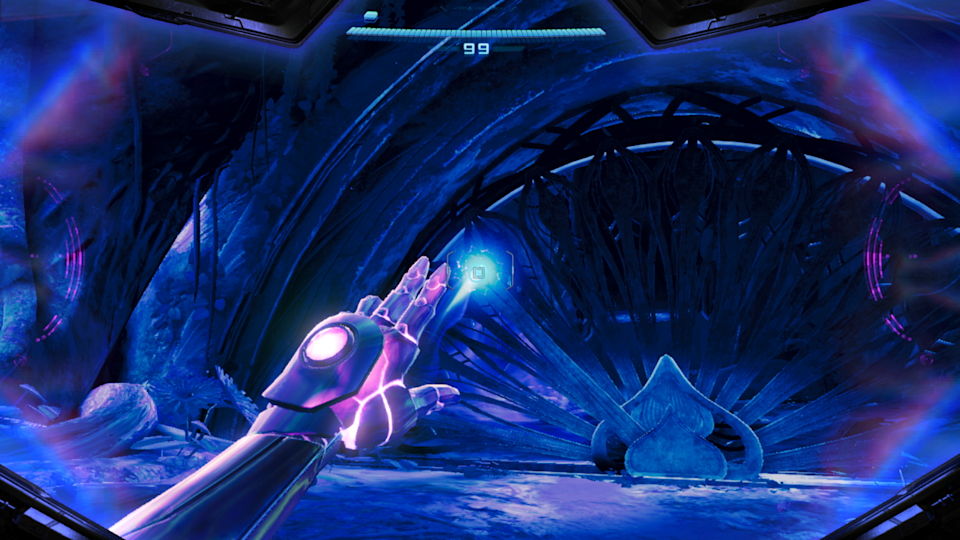
The opening cinematic showcases HDR-enhanced explosions and a richly detailed space station in chaos, filled with fires and debris. While Nintendo games rarely aim for realism, Metroid Prime 4: Beyond edges closer to titles like Horizon Forbidden West or Cyberpunk 2077 than anything else in Nintendo’s catalog. Textures on metal surfaces, alien foliage and even Samus’ gloves are impressively detailed. While Nintendo often leans into stylized visuals by choice, the Switch 2 hardware clearly helps push this game toward a more lifelike presentation.
(Metroid Prime 4: Beyond is also available on the original Switch, though I didn’t test that version. If you’re considering playing it on older hardware, it’s probably wise to see how performance and visuals hold up there before committing.)
Narratively, the intro establishes the central conflict. As Samus attempts to secure the artifact, longtime antagonist Sylux appears, throwing everything into chaos. Samus and several Federation soldiers are transported to the planet Viewros, where she encounters the Lamorn, a nearly extinct civilization. Through telepathic communication, a Lamorn elder asks Samus to help preserve their legacy and potentially save them from oblivion. They’ve been awaiting a “chosen one,” and, unsurprisingly, Samus fits the role.
During this sequence, Samus acquires her signature new psychic abilities. Chief among them is the Control Beam. By charging your arm cannon in psychic scan mode — a twist on the series’ traditional scanning mechanic — you can fire a beam that slows time and can be guided with the right stick. This allows you to pass the beam through multiple targets, a requirement for solving certain puzzles and weakening enemies.
Outside of the Control Beam, however, many psychic abilities feel like renamed versions of familiar mechanics. Longtime fans will recognize the Spider Ball, which returns here as a “Psychic” variant that functions almost identically. Psychic Ball Tracks must be revealed through scanning, launching Samus to hidden areas that typically reward you with upgrades. Even Samus’ standard weapon gets rebranded as the Psychic Beam, though the game openly states it performs identically to the classic Power Beam. While the Control Beam adds a fresh twist, the rest of the psychic toolkit doesn’t fundamentally change the series’ gameplay.
Samus’ primary objective is to collect five Teleporter Keys scattered across Viewros, which allow her to escape the planet. These keys are located in distinct regions connected by Sol Valley, a sprawling desert hub filled with side activities and upgrades. Sol Valley functions more as a central connector than a true open world, with most of the core gameplay taking place in themed areas like Ice Belt, Volt Forge and Flare Pool. As expected, progression requires unlocking specific weapons, including familiar elemental tools like ice and fire-based beams. Much of this mirrors the original Metroid Prime, from the elemental weaponry to environments resembling icy wastelands and volcanic interiors. The Lamorn themselves echo the Chozo from the first game. Given the original released in 2002, revisiting these ideas feels more nostalgic than lazy.
That said, I was disappointed by how linear the overall progression is. While multiple key locations are introduced early, you can’t approach them in any order. The classic Metroid structure — gaining abilities to unlock previously inaccessible paths — remains firmly in place. I had hoped for a bit more freedom, similar to Breath of the Wild. Still, after nearly completing the game, I came to appreciate how well Nintendo refined the familiar structure.
The control scheme will also feel familiar to returning players. Dual-stick controls make movement and aiming intuitive, but precision can be an issue. Lock-on targeting helps, yet many boss fights require manually aiming at specific weak points while locked on, which takes practice. Using a Switch Pro Controller made a noticeable difference, while Joy-Cons felt less precise. In handheld mode, I often paused major encounters until I could use a proper controller. I’d strongly recommend doing the same.
The game also offers a mouse-style control option using a single Joy-Con. Personally, I found this disorienting and less accurate than traditional stick controls. This may simply come down to personal preference, as I’m far more accustomed to controller-based shooters. I may revisit this option later and reassess.
Among the game’s genuinely new elements is Vi-O-La, Samus’ robotic motorcycle. Unlocked early on, it’s primarily used to traverse Sol Valley quickly. Thankfully, it doesn’t dominate the experience. While there are a few segments centered around it, the bike mostly serves as a convenient traversal tool rather than a core mechanic.
Another concern raised during previews involved Myles MacKenzie, an engineer Samus rescues early in the game. He accompanies her briefly, cracking jokes that some feared would disrupt the series’ trademark solitude. Fortunately, Samus spends most of the game alone. Other Federation soldiers appear occasionally, but their presence is brief. Myles mainly serves as a support character, offering upgrades and radio hints. While his guidance can be a bit heavy-handed at times, I appreciated having direction instead of wandering aimlessly.
In terms of difficulty, Beyond generally feels fair. Boss encounters offer generous ammo and energy drops, making them challenging but manageable. I died several times while learning attack patterns, but rarely felt frustrated — until the final stretch. Two late-game bosses, including the final one, spike in difficulty so sharply that they felt out of place and nearly soured the experience.
There were also moments where I felt completely lost, with vague instructions like being told to find someone “in the desert,” which led to far too much aimless wandering. Still, getting stuck is practically a Metroid tradition.
Overall, the addition of supporting characters adds some texture to the world, even if Samus’ silence feels slightly more awkward as a result. It still suits her enigmatic nature.
In the end, Metroid Prime 4: Beyond is best described as a modernized Metroid Prime. It looks better, plays smoother and offers a few new ideas, but it remains deeply rooted in the series’ established formula. Longtime fans will find a lot to enjoy, even if they hoped for bolder innovation. Newcomers, on the other hand, will discover that Nintendo’s early-2000s design still holds up remarkably well. Despite moments of frustration — especially near the end — the long wait was worth it. Metroid Prime 4: Beyond is challenging, distinctive and absolutely worth playing.