
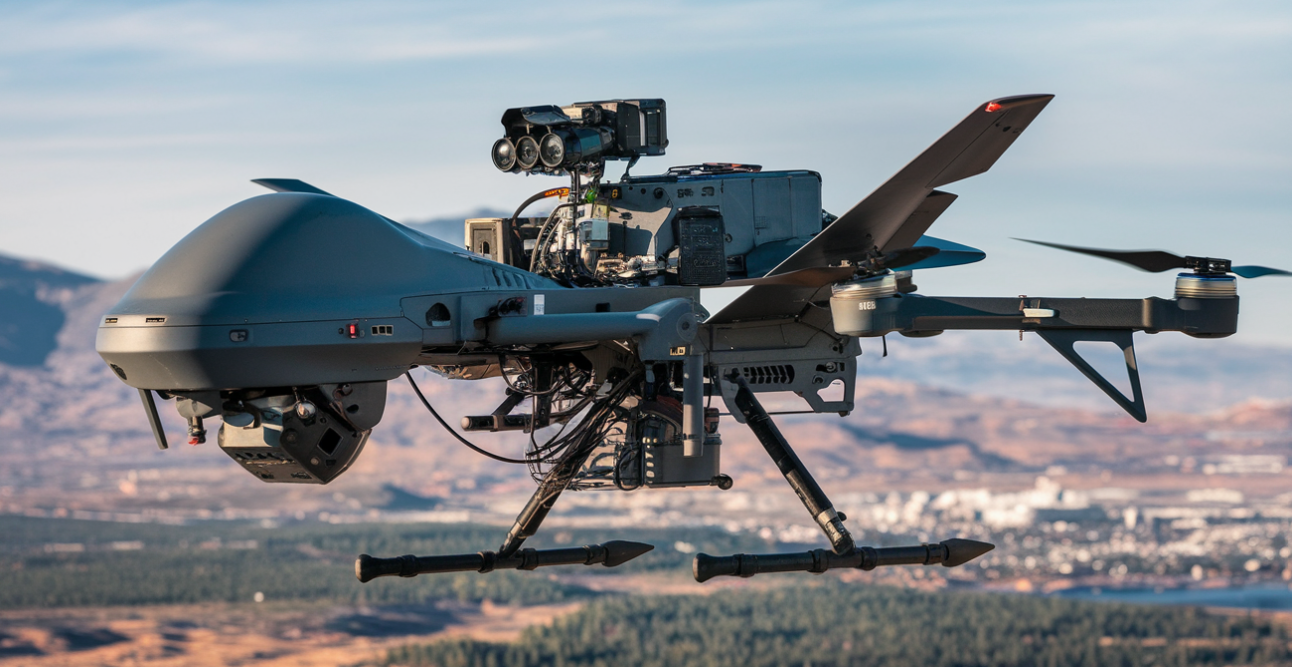
By 2026, autonomous drone systems have become one of the most strategically significant technologies in modern military operations. Their role is no longer limited to surveillance or targeted strikes. Instead, they now operate as coordinated, intelligent networks capable of logistics, reconnaissance, electronic warfare, and mission execution with minimal human input.
This shift is not about futuristic “robot armies.” It is about efficiency, scalability, and reducing human exposure to risk in increasingly complex conflict environments.
Military analysts describe this transformation as a move from remotely controlled systems to mission-autonomous networks — where drones interpret objectives, adapt in real time, and coordinate with other systems independently.
From Remote-Controlled Drones to Autonomous Systems
Early military drones were extensions of human operators. Systems like Predator and Reaper required constant remote control and communication links. While effective, they were expensive, vulnerable to interference, and limited by human reaction time.
The breakthrough came when autonomy shifted from optional to essential.
Modern drone systems no longer rely on continuous operator control. Instead, they execute defined mission goals using onboard AI models that allow them to:
Navigate without constant guidance
Adapt to signal jamming or environmental disruption
Coordinate with other drones in real time
Continue missions even when communication is lost
This evolution turned drones from tools into distributed systems of intelligence.
The Real Transformation: From Firepower to Logistics and Intelligence
Contrary to public perception, the most important drone advancements in 2026 are not focused on weapons capability. Instead, they center on logistics, reconnaissance, and battlefield awareness.
Military operations increasingly depend on autonomous systems for supply delivery, terrain mapping, surveillance, and electronic signal monitoring.
For example, autonomous surface and aerial systems are now used to transport supplies in contested environments where traditional logistics convoys would be too vulnerable.
In parallel, drone swarms provide continuous intelligence gathering, feeding real-time battlefield data into command systems that adjust strategies dynamically.
This shift represents a fundamental change: warfare is becoming data-driven rather than firepower-driven.
Drone Swarms and Networked Intelligence
One of the most significant developments is the rise of coordinated drone swarms.
Instead of single high-value drones, modern systems deploy large groups of low-cost autonomous units that communicate with each other and operate as a collective intelligence layer.
These swarms can divide tasks automatically — with some drones focusing on surveillance, others on signal mapping, and others on environmental scanning.
If one unit is lost, the system adapts instantly without mission failure.
This redundancy makes drone networks extremely resilient and difficult to disrupt.
The underlying principle is simple: quantity combined with intelligence creates robustness that traditional systems cannot match.
Electronic Warfare and Signal Resilience
Another major area of advancement is resistance to electronic interference.
Modern autonomous drones are designed to operate in environments where GPS signals are jammed or communication networks are degraded.
Instead of relying solely on external positioning systems, they use onboard mapping, sensor fusion, and machine learning models to maintain awareness of their environment.
They can also share environmental data with nearby units, effectively building a decentralized navigation system.
This allows drone operations to continue even in heavily contested electronic warfare zones, where traditional systems would fail.
Why Militaries Are Rapidly Adopting Autonomous Drone Systems
The adoption of autonomous drone technology is driven by three primary factors.
First, cost efficiency. Smaller autonomous systems are significantly cheaper to produce and deploy compared to traditional aircraft or manned vehicles.
Second, risk reduction. Machines can be deployed in environments that would be too dangerous for human personnel.
Third, operational scale. Autonomous systems can operate continuously, in large numbers, without fatigue or rotation cycles.
Together, these advantages are reshaping military planning at a structural level.
Instead of focusing on a few high-value assets, militaries are increasingly investing in distributed networks of autonomous systems.
The Strategic Shift: Human Decision-Making Moves Up the Chain
As drones become more autonomous, human operators are moving away from direct control and toward strategic oversight.
Rather than piloting individual units, humans now define mission parameters, rules of engagement, and operational boundaries.
AI systems handle execution within those constraints.
This creates a layered decision structure where humans set intent, and machines handle execution.
While this increases efficiency, it also introduces new challenges around accountability, verification, and oversight in high-speed environments.
Ethical and Security Challenges of Autonomous Drone Warfare
The rise of autonomous systems raises complex ethical and security questions.
One major concern is decision transparency. As AI systems make more tactical decisions, understanding why a system acted in a certain way becomes more difficult.
Another concern is escalation risk. Autonomous systems operating at high speed may respond to perceived threats faster than human operators can intervene.
There is also the issue of proliferation. As drone technology becomes cheaper and easier to produce, non-state actors gain access to capabilities that were once restricted to advanced militaries.
This democratization of military-grade autonomy is reshaping global security dynamics.
Five Key Trends Shaping Autonomous Drone Technology by 2026–2030
1. Fully Autonomous Mission Execution
Drones will increasingly operate from start to finish without human intervention, executing predefined objectives across complex environments.
2. Swarm-Based Battlefield Systems
Coordinated drone networks will replace single high-value units, increasing resilience and operational flexibility.
3. AI-Driven Electronic Warfare Adaptation
Systems will dynamically adjust to jamming, spoofing, and signal disruption in real time.
4. Logistics Automation at Scale
Autonomous aerial and surface vehicles will become standard for supply chains in conflict zones.
5. Human-AI Command Layers
Military decision-making will evolve into hybrid systems where humans set strategy and AI executes operations within defined constraints.
Global Impact: Beyond the Battlefield
The influence of autonomous drone technology extends beyond military applications.
Technologies developed for defense are increasingly used in disaster response, border monitoring, wildfire tracking, and humanitarian logistics.
Drone systems capable of autonomous navigation and coordination are already being adapted for search and rescue operations and infrastructure inspection.
This dual-use nature of the technology ensures rapid advancement — but also increases the importance of regulatory frameworks and international agreements.
Conclusion: Warfare Becomes Distributed, Autonomous, and Data-Driven
By 2026, autonomous drone technology has fundamentally changed how modern conflicts are conducted.
The battlefield is no longer defined by isolated machines or direct human control. It is defined by networks of autonomous systems that sense, decide, and act within strategic boundaries set by humans.
The key transformation is not increased destruction, but increased autonomy and speed of execution.
As this technology continues to evolve, the central challenge will not be technical capability — but governance, control, and accountability in systems that can operate faster than human oversight.
Autonomous drones are not just changing warfare. They are changing the structure of decision-making itself.